Web & SEO / 5 MIN READ
SEO, AEO and GEO: a practical content checklist for growing brands
THE SHORT ANSWER
Build useful, crawlable pages that answer a real customer question. Add first-hand examples, clear author details, supporting sources and relevant service links. These fundamentals support search discovery and make content easier to understand; no format guarantees an AI citation.
# SEO, AEO and GEO: A Practical Content Checklist for Growing Brands
Most businesses don’t struggle to find something to post. They struggle to decide what is worth saying.
A customer asks a useful question during a call. Someone gives a detailed answer on WhatsApp. The same concern comes up in three discovery meetings. Then the team sits down to plan the blog and starts searching for new topics.
Those everyday conversations are often the best place to begin.
If you’re planning content around SEO, AEO and GEO, start with the questions your customers are already asking.
Pick one question and answer it properly
“Website development” is a service category. “What do I need to prepare before hiring a website developer?” is a question you can build an article around.
The second gives you a clear reader and a clear job to do.
Write the answer near the top. If there are conditions, explain them. If the answer depends on budget, business size or project scope, say so.
Someone visiting your page should not have to read six paragraphs about the importance of having a website before finding the information they came for.
Know the terms without getting caught up in them
SEO, AEO and GEO overlap, which can make the conversation unnecessarily complicated.
SEO is about helping people find your pages through search.
AEO is commonly used to describe making answers clear and easy to understand in search and assistant experiences.
GEO usually refers to visibility in generative search and AI-generated answers.
The names are useful for discussing the work. They shouldn’t dictate every sentence you publish.
A page still needs accurate information, a sensible structure and a reason for someone to read it. Adding an FAQ section or rewriting every heading as a question won’t guarantee visibility.
Give the page a structure that makes sense
Think about how you read a page when you’re busy. You check the title, scan the headings and look for the part that answers your question.
Build your article for that reader.
Use a descriptive title. Keep paragraphs manageable. Give each section a clear purpose. Put important information in the page text, even if you also include it in a graphic.
Internal links should help someone continue their research. If you mention website maintenance in a development article, link to a relevant explanation rather than sending them to an unrelated service page.
Before publishing, check the technical basics too: the page should be accessible to search crawlers and included in the sitemap.
Include something from your own experience
An article becomes more useful when it explains a detail the reader might otherwise miss.
Take a guide about getting a website quotation. You could explain why “we need five pages” is rarely enough information to estimate the work. A booking system, product catalogue, payment integration or content migration can change the scope considerably.
That is a practical example. It helps the reader prepare a better brief without relying on an impressive-sounding statistic.
When you share client work, get permission and provide context. If you mention results, include the timeframe and explain what was measured. If something is an estimate or your opinion, label it clearly.
You don’t need a dramatic success story in every post. A useful observation is enough.
Use FAQs for the questions left unanswered
By the end of an article, a reader may still have a few practical doubts.
For a website project, these might be:
- Do we need to supply the copy and images?
- Can our team update the website after launch?
- Are hosting and maintenance included?
Answer those questions plainly. If you have already covered something properly in the article, there is no need to repeat it in slightly different words.
Keep the FAQ section because it helps the reader, not because a template says every blog needs one.
Revisit the posts you already have
Service details change. Links stop working. Advice about a platform can become outdated.
Set aside time to review older articles, particularly the ones people still visit or your team regularly shares with prospects.
Ask whether you would give the same advice to a customer today. If you wouldn’t, update it.
Make meaningful corrections, replace outdated examples and identify the person or team responsible for the content.
End with a next step that fits
Consider what the reader is likely to need next.
After an article about planning an ad shoot, a production checklist could be useful. After a guide to website costs, they might want to understand what is included in a project.
Some readers will be ready to enquire. Others will need more information first.
Give them a relevant option without turning the final paragraph into a list of everything your agency sells.
Before you hit publish
Read the draft once as if you were the customer. Then check:
- Have we answered the main question early?
- Is any advice too vague to be useful?
- Are the examples accurate and approved for sharing?
- Have we checked the claims and source links?
- Do the title and search description match the article?
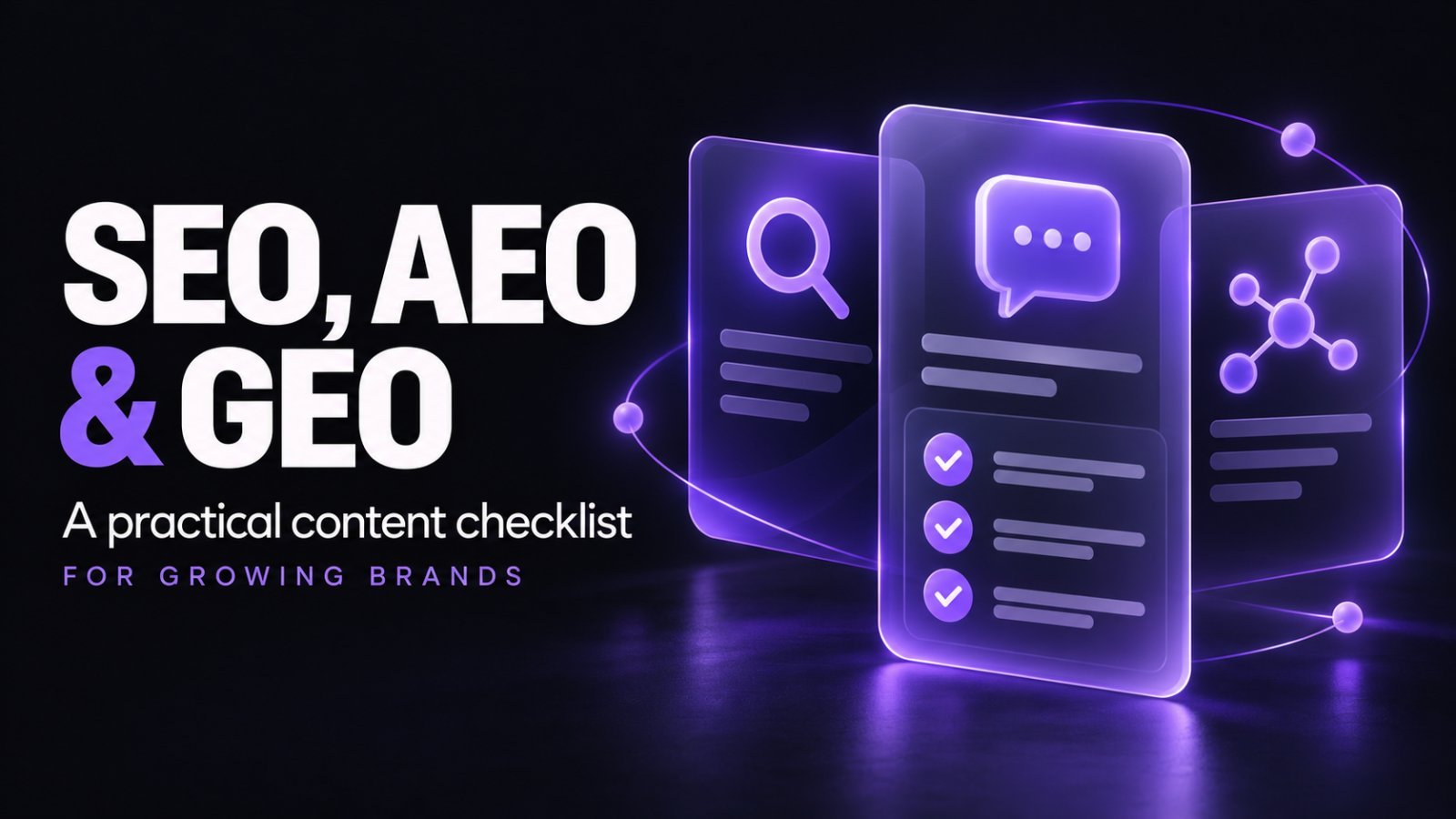
- Does the image alt text describe the cover?
- Do all internal links work?
- Have we previewed the page on mobile?
- Does the next step fit the topic?
You may find that the most useful edit is deleting an introduction, replacing a broad claim with an example or explaining a term your team takes for granted.
Start with one customer question. Give it the attention it deserves. That is a workable starting point for your next post.
Questions, answered.
Does structured data guarantee an AI citation?
No. Structured data can help describe the page, but it does not guarantee crawling, indexing, rankings or inclusion in AI answers.
Should every article target a city?
Only when the place matters to the reader and the business actually serves that market. Use real local context rather than repeating city names.
Sources & further reading
Put the idea to work.
Let’s connect your next creative move to a clear business goal.
Start a project ↗ Explore the service